After the energy and materials transition, biophilic architect Daan Bruggink is once again preparing for the next big trend in the built environment: “Wood is beautiful, but what really matters is that buildings make us happy.”
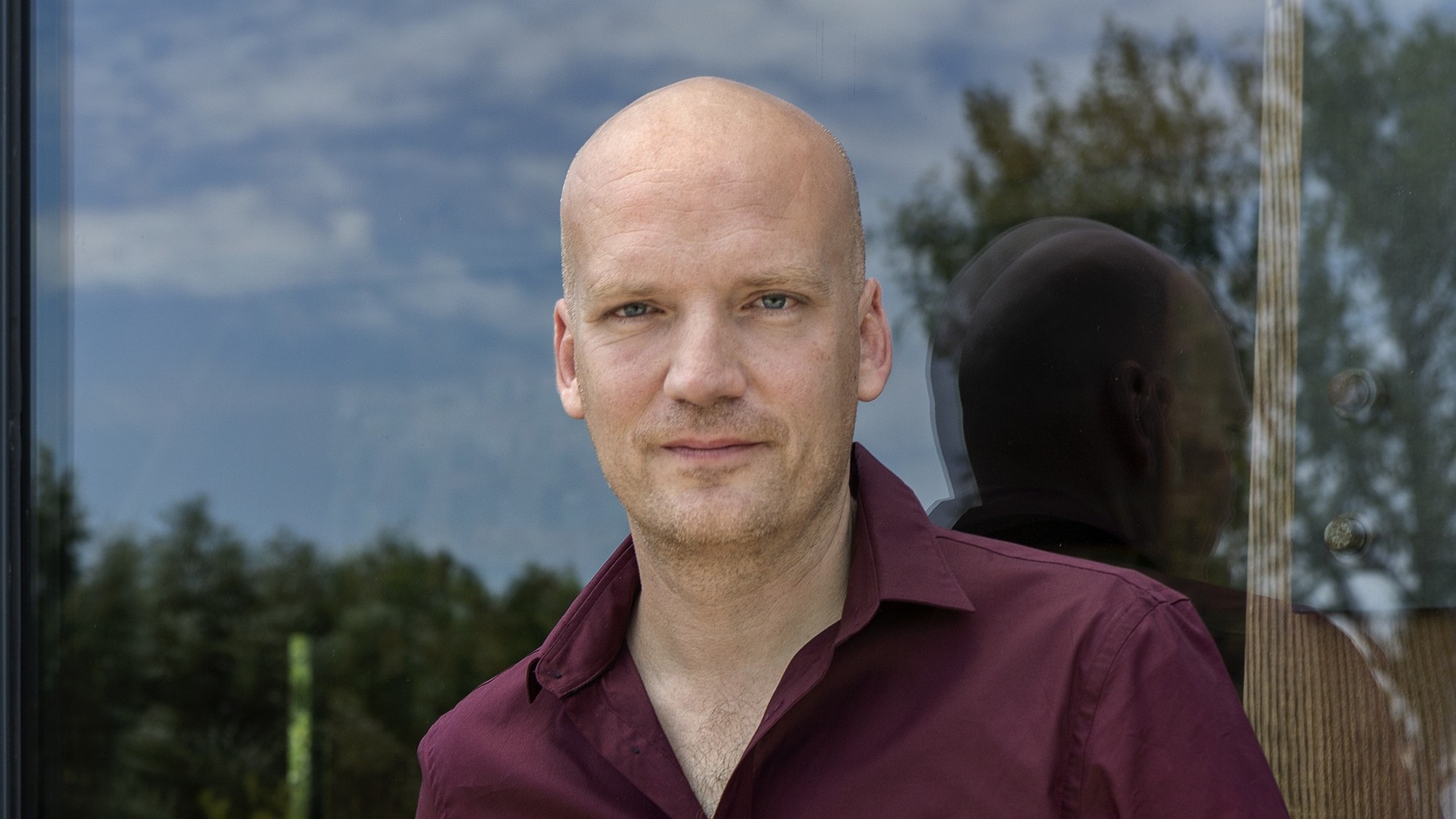
If he were a tree, he’d be the kind that neither bends nor breaks—certainly not one that sways with every passing wind. No, Daan Bruggink is not a man of compromise; he stands firmly by his principles, which he draws directly from nature. It’s called biophilic building—or in his case, biophilic design.
Had he been more willing to water down his ideals, the already respectable annual turnover of his firm Orga Architect (known to the editors) would probably be many times higher, he admits with a nod. But Bruggink doesn’t live for money.“For us, ‘can’t’ simply doesn’t exist. The higher the sustainability bar, the better. Sure, that sometimes costs me some very cool projects.”
That approach has already earned him numerous awards and honors. In 2012, the pioneer of construction with renewable materials was named Talent of the Year (Dutch Construction Award). Most of his prizes came for De Verwondering (“The Wonder”), an ecological school in Almere — the very first of its kind in the Netherlands, according to building experts.
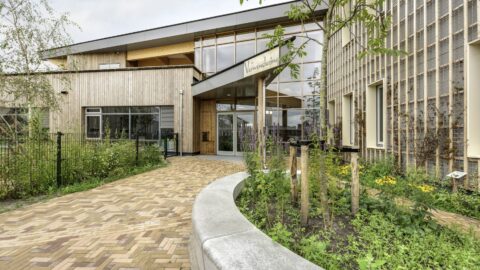
De Verwondering. De eerste ecologische school van Nederland. Photo | Ruben Visser
For Bruggink, no mountain seems too high—or, to put it differently, no sustainable building is sustainable enough. His vision has not only brought him accolades, but also a steady stream of like-minded clients who know exactly what they want, and who know that Bruggink is the one who can deliver it. And anyone who thought he might lay down his tools now that timber and bio-based construction (something he has long advocated for) have gone mainstream, would be mistaken.
Bruggink has already moved on to the next chapter — preparing for the next transition: the transition of well-being. In his view, homes and buildings should not only be climate-positive, but also regenerative — designed to make people healthier and happier.
“Building with timber and bio-based materials has taken off since COVID, the nitrogen crisis, and the 2019 TV documentary Houtbouwers (‘Wood Builders’). How have the past few years been for you?”
“Fantastic. We’re getting many new inquiries. Clients come to us deliberately when they want a truly sustainable building. That flow of work is great, but at the same time, we sometimes see amazing projects slip through our fingers.”
“You’re always looking for new challenges. What exciting project are you working on right now?”
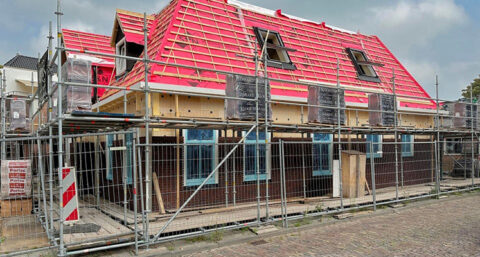
“Thirty floating homes. Apart from the concrete base, they’re entirely bio-based, with green roofs that connect visually and ecologically to the water. That’s really something special in the Netherlands.”
“What makes this project so special?”
“The potential is huge — there are countless gravel and sand excavation sites. At the same time, building on water is still a real exploration, still very much in development. Legally, it’s complex, and banks find it difficult too. They ask: what’s my collateral without land? How do I finance this?”
“What kind of clients do you attract? Are they always deep-pocketed?”
“Usually entrepreneurs and family businesses. They tend to care more about their employees, aren’t just profit-driven, and see our biophilic and health-focused approach to design and construction as an investment that pays itself back.”
“Can you give an example?”
“It started with a dentist in 2013. He came to me wanting an ecological dental practice — lots of greenery, daylight, and durable materials. It was a building with four treatment rooms. I asked: why do you want that? He said, ‘I want to create a pleasant environment where people feel as if they’re in their own living room. The more relaxed they are, the faster I can treat them.’
Within a year, he had earned back his investment. His staff enjoyed their work more, started fifteen minutes earlier, and left fifteen minutes later. Absenteeism and staff turnover dropped significantly.”
Text continues after this image.
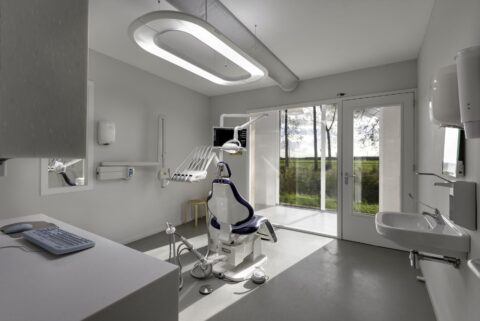
‘Give me a sustainable practice,’ the dentist had said. ‘I want people to feel at home.’ Photo | Ruben Visser
“A building that makes people happy — is that the future?”
“I think so, yes. As I said, we often work with family businesses. They look at value differently and see, for instance, the competition for staff as a motivation to invest in buildings that make people happy. In Silicon Valley, they’ve understood that perfectly well for years.”
“Do Dutch investors already see that this is where things are headed?”
“Slowly but surely. The fact that big construction firms like Heijmans and BAM are now building timber homes is a great sign — I love it. But I still sometimes encounter the unfounded fear that a bio-based house won’t sell. In Weesperhout, we proved the opposite: of the sixteen homes we built there, a hundred people signed up — they sold out within a week and a half.”
“But the fact that timber construction is now being widely embraced doesn’t entirely reassure you?”
“No, because there are many more challenges ahead. I’d be really sad if people thought we’d ‘made it’ just because we’re now building timber houses, neighborhoods, and schools. Sure, it’s great if that helps solve the CO₂ problem — but if all biodiversity dies as a result, we still end up with nothing.”
Bruggink opens his laptop and shows an analysis and model he’s been developing — a kind of evolutionary theory of the built environment.
“Look, right now we’re in the parasitic era,” he says. “We need to move toward an era of symbiosis — the long-term coexistence of organisms and species in nature.”
“How far away are we from that as a construction sector?”
“Very far. Just last week came the news that we’ve crossed yet another planetary boundary: ocean acidification.”
“Will it ever turn out all right?”
“Yes — I’m always optimistic. I often say that nature has enormous regenerative power and doesn’t need us at all — let alone evolution itself. From nature’s perspective, that’s actually comforting. Besides, I don’t think there’s anyone on this planet who truly wants to ruin their own home… Well, maybe Donald Trump — he’s well on his way.”
TOEKOMSTDENKERS
In the Future Thinkers series, we interview pioneers from across the sector about their dreams, actions, and visions of the future. How do they anticipate the sometimes still-unknown societal challenges of tomorrow? What do they see, and what solutions do they propose?
Do you know a visionary architect, builder, installer, supplier, developer, student, or scientist who deserves this platform? Email thomas.van.belzen@jaarbeurs.nl, subject line Future Thinkers.

Dit is een artikel van Bouw en Installatie Hub. Wil je op de hoogte blijven van al het nieuws uit de bouw- en installatiesector? Neem dan een kijkje op de hub en meld je aan voor de online community.
↗